Multi-Agent Orchestration Explained: How Collaborative AI Systems Outperform Single Agents
A single AI agent is impressive until you give it a genuinely complex task.
Ask it to generate a board-level quarterly review - pulling financial data from three systems, synthesizing market context from internal and external sources, writing an executive narrative, and verifying the output for factual accuracy - and you will quickly encounter the limits of what a single agent can reliably do. Context windows fill up. Reasoning quality degrades when too many subtasks compete for attention. Errors in early steps compound through later ones with no mechanism for correction.
The solution is the same one organizations have always used when a task is too complex for one person: divide it among specialists who each handle the part they are best equipped for, coordinate their work, and combine their outputs into something none of them could have produced alone.
Multi-agent orchestration is the architectural pattern that makes this possible for AI systems. It is also the pattern that separates enterprise-grade AI deployments from sophisticated demos - because the workflows that produce the most business value are almost always too complex for a single agent to handle reliably.
This guide explains how multi-agent orchestration works, why it outperforms single-agent approaches for complex tasks, and what it takes to build and deploy orchestrated agent systems in practice.
The Limits of a Single Agent
To understand why multi-agent systems exist, it helps to be precise about where single agents break down.
A single agent operates within a context window - the amount of information it can hold in working memory at one time. Current frontier models have context windows large enough to handle substantial tasks. But context window size is not the only constraint, and often not the binding one.
The more significant limitation is cognitive load. When a single agent is responsible for data retrieval, analysis, synthesis, writing, and verification simultaneously, the quality of each individual function degrades. The agent that is trying to write an executive narrative while also tracking whether its financial data is internally consistent is doing neither task as well as a specialized agent would.
There is also the question of tool access and permissions. A single agent with access to every tool and data source in an organization is a security and audit nightmare. Fine-grained access control - where each agent has access only to the specific tools and data its role requires - is easier to implement and audit in a multi-agent architecture where roles are distinct.
Finally, there is the question of error propagation. In a single-agent workflow, an error in step three affects everything that follows, with no independent review mechanism to catch it before it reaches the output. In a well-designed multi-agent system, agents can review each other's outputs, flag inconsistencies, and trigger correction loops before errors reach the final result.
None of this means single agents are not useful. For well-scoped, contained tasks - answering a specific question, summarizing a specific document, executing a specific query - a single agent is often the right architecture. The multi-agent pattern becomes the right architecture when the task is complex enough that the quality, reliability, and auditability of a single-agent approach is insufficient for production use.
What Multi-Agent Orchestration Actually Is
Multi-agent orchestration is a system architecture in which multiple AI agents, each with a defined role and a specific set of tools and permissions, collaborate on a shared goal under the coordination of an orchestration layer that manages task assignment, context sharing, handoffs, and error handling.
The key elements of that definition are worth unpacking individually.
Multiple agents with defined roles. Each agent in an orchestrated system has a specific job. A data analyst agent. A research agent. A writer agent. A review agent. The specificity of the role definition is what enables specialization - and specialization is what produces quality that exceeds what a generalist agent achieves. A legal review agent trained specifically on contract language, operating with access specifically to contract documents and legal policy references, will perform contract review better than a generalist agent with access to everything.
Specific tools and permissions per agent. Each agent has access only to what its role requires. The data analyst agent has read access to the data warehouse. The research agent has access to internal document stores and web search. The writer agent has access to the outputs passed to it by other agents. The review agent has access to both the draft output and the source data it is checking for accuracy. This is not just good security practice - it is good system design. Constraining an agent's tool access focuses its behavior and makes its outputs more predictable and auditable.
An orchestration layer. Something needs to manage the overall workflow - deciding which agent runs when, passing outputs between agents, handling errors and retries, maintaining shared context, and delivering the final result to its destination. This is the orchestration layer. In simple sequential workflows, the orchestration logic can be straightforward. In complex workflows with parallel execution, conditional branching, and human-in-the-loop checkpoints, the orchestration layer is itself a sophisticated system.
Shared context. Agents in an orchestrated system need to operate on a shared understanding of the goal, the constraints, and the work already done. Without shared context, agents work in isolation and their outputs do not combine coherently. The mechanism for maintaining shared context - how information is passed between agents, what each agent knows about what others have done, how the overall state of the workflow is tracked - is one of the most important design decisions in any multi-agent system.
The Three Orchestration Patterns
Multi-agent systems can be organized in three fundamental patterns. Each has distinct strengths, and the right pattern depends on the nature of the task.
Sequential Orchestration
In sequential orchestration, agents execute in a defined order. Agent A completes its task and passes its output to Agent B, which completes its task and passes to Agent C, and so on. Each agent's output becomes part of the input for the next.
Sequential orchestration is the right pattern when tasks have strong dependencies - when the output of one step is genuinely necessary for the next step to proceed meaningfully. Writing a financial narrative requires the financial data to exist first. Reviewing a document for accuracy requires the document to exist first. The sequential pattern makes these dependencies explicit and ensures each step has what it needs before it begins.
The risk in sequential orchestration is error propagation. If Agent A produces a flawed output, that flaw flows into Agent B's input and compounds through the rest of the pipeline. Mitigation strategies include validation steps between agents, explicit checks before handoffs, and retry logic when an agent's output fails a quality threshold.
A good example: a competitive intelligence brief that requires a research agent to gather information, a synthesis agent to identify key themes, a writing agent to produce the brief, and a fact-check agent to verify claims before the brief is distributed.
Parallel Orchestration
In parallel orchestration, multiple agents execute simultaneously on different aspects of the same goal, and their outputs are combined by an orchestrator or a dedicated synthesis agent when all parallel threads complete.
Parallel orchestration is the right pattern when subtasks are independent - when Agent A's work does not depend on Agent B's output, and both can run at the same time. This dramatically reduces total execution time for complex workflows and allows each specialized agent to operate with full attention on its specific subtask.
A good example: a market analysis report that requires one agent to analyze internal sales data, a second to research competitor activity, a third to pull relevant industry news, and a fourth to analyze customer feedback - all simultaneously - before a synthesis agent combines their outputs into a coherent analysis.
The coordination challenge in parallel orchestration is ensuring the synthesis step works correctly when the parallel threads produce outputs of variable length, quality, or format. The synthesis agent needs to be robust enough to handle the variability in what it receives.
Hierarchical Orchestration
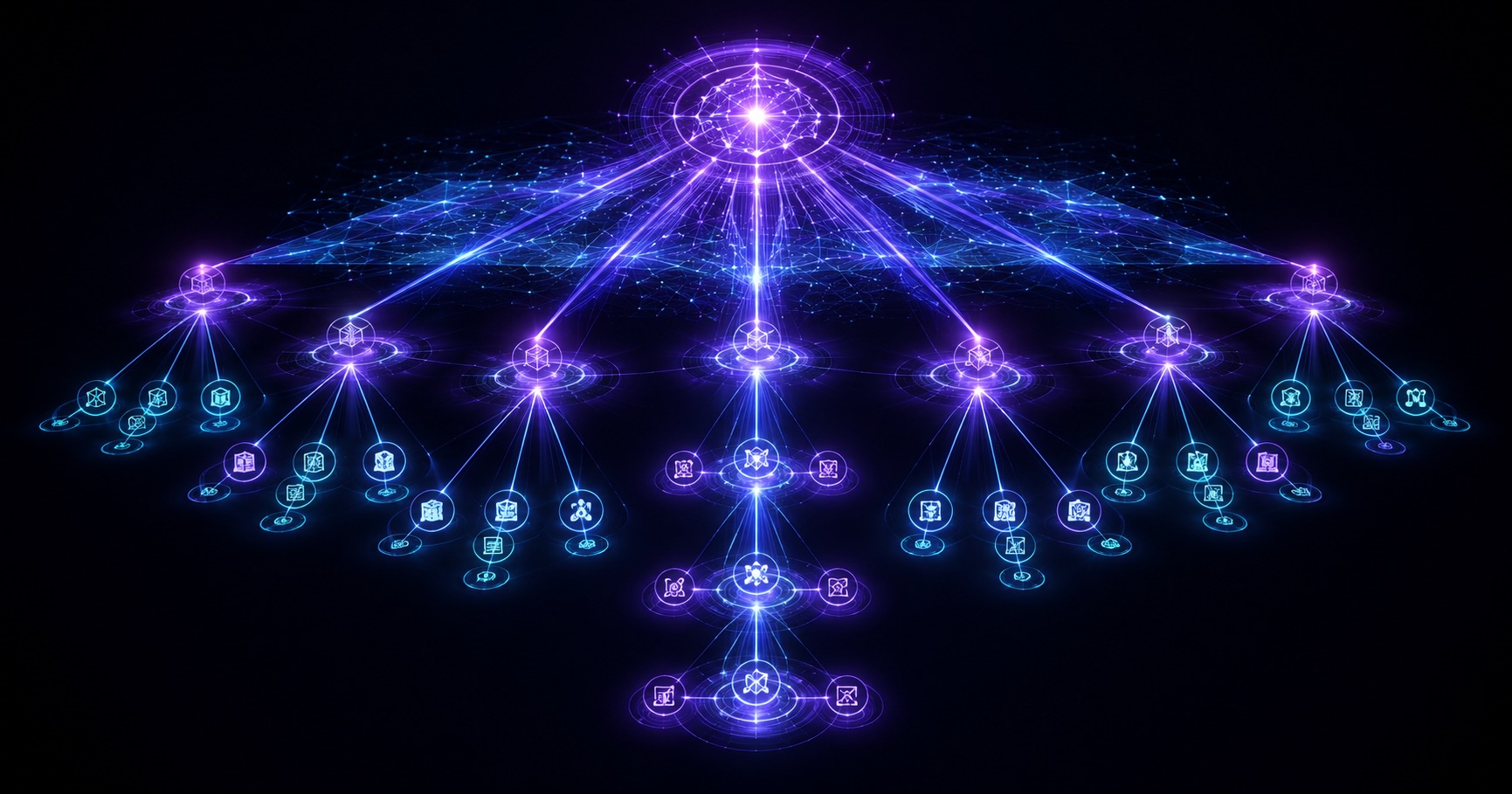
In hierarchical orchestration, a manager agent receives the overall goal, decomposes it into subtasks, dynamically assigns those subtasks to specialist agents, monitors their progress, handles exceptions, and assembles the final output. The specialist agents report back to the manager agent rather than directly to each other.
Hierarchical orchestration is the right pattern for complex, variable tasks where the optimal decomposition is not fully known in advance - where the manager agent needs to exercise judgment about how to divide the work based on the specific characteristics of the goal it receives.
This is the most powerful and most complex of the three patterns. It produces the most flexible and capable systems. It is also the most difficult to design, test, and debug, because the manager agent's decomposition decisions significantly affect the quality of the final output and those decisions are dynamic rather than predetermined.
A good example: an enterprise research workflow where a manager agent receives an open-ended business question - "what are the key risks to our Q3 revenue forecast?" - and dynamically assigns research tasks to specialist agents based on its assessment of what information is needed to answer the question thoroughly.
In practice, most sophisticated enterprise workflows combine elements of all three patterns. A hierarchical manager agent might spawn both sequential and parallel subtask pipelines depending on the dependencies in a specific task.
Why Specialization Produces Better Outputs
The core argument for multi-agent systems over single-agent systems is specialization - and it is worth making this argument precisely, because it is sometimes dismissed as theoretical.
Consider two approaches to contract review. In the first, a single generalist agent reads a contract and produces a review. It has access to the company's legal playbook, the full text of the contract, and general legal knowledge from its training. In the second, a specialized legal review agent is built specifically for contract review. Its system prompt is tuned specifically for contract analysis. Its tool access is limited to legal documents and the approved playbook. It has been tested extensively against a library of contracts and its outputs have been refined based on feedback from the legal team.
The specialized agent will consistently outperform the generalist on this specific task. Not because it is a more powerful model - it might be running on the same model - but because its context is focused, its instructions are precise, and its behavior has been tuned for the specific task.
Now extend this logic to an orchestrated system where the contract review agent is one component. A document intake agent handles the initial processing and normalization of the contract regardless of format. A clause extraction agent identifies and categorizes each clause type. The review agent assesses each clause against the playbook. A summary agent generates the structured review output. A routing agent delivers the review to the appropriate legal team member based on the contract type and value.
Each agent does one thing. Each does it well. The combined output is more reliable, more structured, and more auditable than any single agent could produce.
This is the specialization argument for multi-agent systems: it is not that any individual agent is dramatically more capable in isolation. It is that a system of specialized agents produces compound quality improvements across complex workflows that a single generalist agent cannot match.
How Shared Context and Memory Work
The technical challenge that makes multi-agent system design hard is state management. Each agent needs access to the right information at the right time. That information changes as the workflow progresses. And the total information across a complex workflow quickly exceeds what any single agent can hold in its context window simultaneously.
Enterprise-grade multi-agent platforms solve this through several complementary mechanisms.
Structured message passing is the foundation. When one agent completes a task and hands off to the next, it passes a structured output - not a raw response, but a formatted data structure with defined fields - that the receiving agent can reliably parse and act on. Unstructured message passing between agents, where Agent A dumps its full response and Agent B tries to interpret it, produces brittle systems that break when outputs vary from the expected format. Structured passing is more work to design upfront and dramatically more reliable in production.
Shared working memory gives all agents in a workflow access to a common store of context about the current task - the original goal, key parameters, decisions made earlier in the workflow, and outputs produced so far. This is distinct from each agent's individual context window. Think of it as a shared whiteboard that any agent can read from and write to, so that no agent needs to hold the entire workflow history in its own context.
Vector memory for long-term context handles the information that persists across workflow executions - organizational knowledge, historical precedents, policy documents, and similar reference material. When an agent needs to retrieve relevant context - the relevant clause from the legal playbook, the historical precedent for a particular deal type, the policy that governs a specific employee situation - it queries the vector memory store and retrieves the most semantically relevant content. This allows agents to operate with access to organizational knowledge that would be too large to include in any individual context window.
State synchronization ensures that when multiple agents are running in parallel, their shared working memory remains consistent and conflicts are handled correctly. If Agent A and Agent B are both running simultaneously and both need to write to the shared state, the orchestration layer needs to manage those writes in a way that does not produce race conditions or inconsistent state.
Getting these mechanisms right is the difference between a multi-agent system that works reliably in production and one that works in demos and fails under real-world conditions. It is also one of the most important things to evaluate when selecting an enterprise AI agent platform - not whether the platform supports multi-agent systems in principle, but how it handles state management and context sharing in practice.
A Worked Example: A Board Report Generated by a Four-Agent System
Abstract explanations of multi-agent architecture become concrete when you trace a real workflow end to end. Here is a detailed walkthrough of a board-level quarterly report generated by an orchestrated four-agent system.
The goal: Generate the Q2 board pack executive summary - a 1,200-word narrative covering financial performance, pipeline health, operational highlights, and strategic risks - by 6am on the first Monday of the quarter, delivered to the board secretary's email as a formatted document.
The workflow:
The orchestrator receives the goal at 5am. It initializes the shared working memory with the goal parameters, the output format specification, and the distribution list. It then launches the first two agents in parallel.
Agent 1 - The Data Analyst has read access to the company's Snowflake data warehouse and Salesforce CRM. It runs a predefined set of SQL queries covering revenue actuals versus forecast, gross margin by product line, headcount and burn rate, pipeline value and velocity, win rate versus the prior quarter, and customer retention metrics. It structures the results into a standardized data schema and writes them to shared working memory. Execution time: approximately four minutes.
Agent 2 - The Research Agent runs simultaneously. It has access to the internal document store - board packs from the previous three quarters, the annual operating plan, the strategic plan, and the risk register. It retrieves the prior quarter's board summary for context, the relevant sections of the operating plan for comparison against actuals, and the current risk register entries flagged as board-level. It structures this context and writes it to shared working memory alongside the financial data. Execution time: approximately three minutes.
When both agents complete, the orchestrator confirms that shared working memory contains valid outputs from both and launches the next agent.
Agent 3 - The Writer Agent has access to the shared working memory containing the financial data and the research context. It also has access to the output format specification - section structure, word count targets per section, tone guidelines, and the board's stated preference for plain language over financial jargon. It generates the 1,200-word executive summary, structured across the four required sections, with specific callouts for items that exceed the variance threshold defined in the format specification. It writes the draft to shared working memory. Execution time: approximately six minutes.
Agent 4 - The Review Agent has access to both the draft narrative from Agent 3 and the source financial data from Agent 1. Its specific function is factual consistency verification: it checks every numerical claim in the narrative against the source data, flags any discrepancy above a defined tolerance, and checks that all section word counts are within the specified range. It produces a structured review report: a pass/fail for each verification check, with specific discrepancy notes where checks fail. In this execution, it identifies one discrepancy - the narrative states pipeline growth as 18% while the source data shows 17.3% - and flags it for correction. Execution time: approximately three minutes.
The orchestrator receives the review report. It identifies the flagged discrepancy and routes it back to the Writer Agent with the specific correction instruction. The Writer Agent updates the single figure and confirms. The orchestrator runs the Review Agent once more on the updated draft. All checks pass.
The orchestrator formats the final narrative as a Word document, attaches it to an email addressed to the board secretary, and sends it at 5:28am - 32 minutes before the 6am deadline.
Total elapsed time: 28 minutes from initialization to delivery. No human involvement. No manual data pulls. No early Monday morning for the finance team.
Failure Modes in Multi-Agent Systems
Multi-agent systems introduce failure modes that do not exist in single-agent architectures. Understanding them is essential for building systems that are reliable in production.
Cascading errors are the most dangerous failure mode. When Agent A produces a flawed output and passes it to Agent B, which builds on that flawed output and passes its result to Agent C, the error compounds through the pipeline in a way that can be difficult to detect and trace. The mitigation is validation between agents - explicit checks on the output of each agent before it is passed to the next - and review agents that independently verify outputs against source data rather than trusting the chain.
Context loss between agents occurs when the shared state mechanism fails or is poorly designed, and a downstream agent does not have access to context that earlier agents established. The result is an agent that re-does work that was already done, makes decisions that contradict earlier decisions, or produces outputs that are inconsistent with the overall workflow state. This is a design problem as much as a technical one - it usually reflects insufficient investment in the shared memory architecture.
Infinite loops occur when two or more agents are waiting on each other's outputs, creating a deadlock, or when a correction loop between agents never converges on an acceptable output. Every orchestrated workflow needs explicit termination conditions and timeout logic that routes to a human escalation path rather than looping indefinitely.
Over-automation of high-stakes outputs is not a technical failure mode but an architectural one. Some outputs should never go directly from an AI agent to their destination without human review - outputs that affect financial decisions above a certain value, communications to external parties in sensitive situations, decisions that affect individual employees. The multi-agent architecture makes it easy to insert human-in-the-loop checkpoints - an approval step where a human reviews and approves the orchestrator's output before delivery - and those checkpoints should be used wherever the consequences of an error are significant.
Observability gaps make debugging multi-agent failures significantly harder than debugging single-agent failures. When a complex orchestrated workflow produces a wrong output, identifying which agent introduced the error and why requires visibility into the state at every step of the workflow - what each agent received as input, what it produced as output, what the shared memory contained at each transition. Platforms that provide step-by-step execution traces and shared memory state logs at each transition make debugging tractable. Platforms that provide only final output logs make it nearly impossible.
What to Look For in an Orchestration Platform
Not all AI agent platforms handle multi-agent orchestration equally. When evaluating platforms specifically for orchestrated workloads, these are the capabilities that separate production-grade systems from those that work in demos.
A visual workflow builder that handles multi-agent flows. You should be able to define the agents, their roles, their tool access, and the orchestration logic - sequential steps, parallel branches, conditional routing, human checkpoints - without writing custom orchestration code for every workflow. The visual builder is how non-engineering team members can understand, validate, and modify workflows without depending on developers for every change.
Explicit error handling and retry logic. The platform should allow you to define what happens when an agent fails - what constitutes a failure, how many retries are attempted, what the fallback behavior is, and when the failure escalates to a human alert. This should be configurable at the workflow level, not buried in platform defaults.
Full execution traces with shared state visibility. Every workflow execution should produce a complete log: each agent invocation, the input it received, the output it produced, the shared memory state at each transition, and the final delivery confirmation. This is essential for debugging, auditing, and improving workflows over time.
Human-in-the-loop checkpoint support. The platform should make it straightforward to insert approval steps where a human reviews and approves an agent's output before the workflow continues. These checkpoints should be configurable - some workflows need them, others do not - and should not require custom development to implement.
Parallel execution with proper state management. If the platform supports parallel agent execution, it needs to handle the state management correctly - ensuring that parallel writes to shared memory are consistent and that the synthesis step has access to all parallel outputs when it needs them. Test this explicitly with a parallel workflow before deploying in production.
Model flexibility per agent. In a well-designed multi-agent system, different agents should be able to run on different models. The data analyst agent might run on a fast, cost-efficient model. The writer agent might run on the best available frontier model for language quality. The review agent might run on a model specifically strong at consistency checking. A platform that forces all agents to use the same model prevents the model-per-task optimization that makes multi-agent systems cost-effective at scale.
Building Your First Multi-Agent Workflow
The natural starting point for organizations new to multi-agent orchestration is a sequential workflow with two or three agents - simple enough to design, test, and understand completely, complex enough to demonstrate the value of the pattern.
The board report example above is a good template. Pick a report or analysis your organization produces regularly on a fixed schedule. Map the steps a human takes to produce it. Identify the natural agent boundaries - where one specialized function ends and another begins. Define the data each agent needs. Design the structured outputs each agent should produce. Implement the validation between agents.
Build it. Test it in a sandbox against historical data. Compare its outputs against the manually produced version. Identify the discrepancies. Refine the agent definitions and the orchestration logic. Deploy with monitoring.
Once a sequential three-agent workflow is running reliably in production, the next step is introducing a parallel branch - identifying two of the agents that have no dependency on each other and running them simultaneously. This is the step where execution time improvements become dramatic and the value of the architecture becomes visceral rather than theoretical.
From there, the progression to hierarchical orchestration and more complex workflows follows naturally - not as a theoretical exercise in system design, but as an organic response to the workflows your organization needs to automate and the limitations of simpler architectures for those workflows.
Multi-agent orchestration is not a destination. It is a design pattern that becomes more powerful as your organization's understanding of it deepens and as the workflows you apply it to become more ambitious. The organizations that start building that understanding now will have a meaningful head start on those that wait until the pattern is fully mainstream.
Ready to see this in action?
Book a 30-minute demo with the RHA OneAI team.