Top 10 High-ROI Enterprise AI Agent Workflows for Sales, Finance, HR, and Operations
Most enterprise AI initiatives fail to deliver measurable financial ROI because they stop at passive assistant interfaces. A conversational assistant that summarizes text or answers employee Q&A provides minor personal productivity gains, but it does not alter the underlying cost structure or operational velocity of an enterprise.
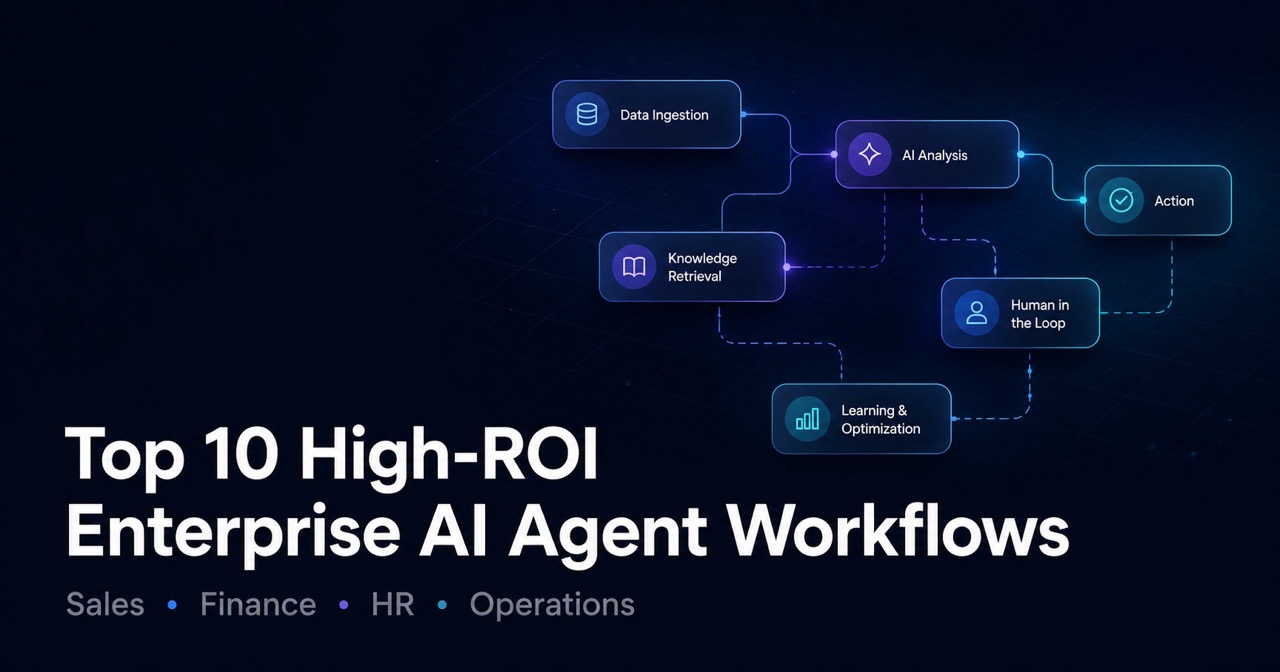
The next phase of enterprise AI isn't about better chatbots - it's about software that can observe, reason, and execute work autonomously. Organizations are moving from AI copilots that assist employees to AI agents that complete business processes under governed, auditable control.
In this comprehensive guide, we examine 10 high-ROI enterprise AI agent workflows across Sales, Finance, HR, and Operations. Each workflow includes technical architecture, realistic operational metrics, anonymized case studies, and common implementation pitfalls.
Data Attribution & Methodology Note: Operational metrics, time savings, and efficiency gains cited throughout this guide represent aggregated benchmark telemetry, customer case studies, and internal pilot deployments across Fortune 500 and mid-market enterprise environments. Actual results vary based on data hygiene, API readiness, and organizational approval policies.
📈 Sales & Revenue Operations Workflows
1. Autonomous Account Research & Deal Risk Spotter
The Problem: Account Executives spend up to 6-8 hours per week manually gathering company filings, news updates, and past CRM records prior to discovery calls. Meanwhile, at-risk enterprise deals stall silently without early warning signals reaching sales leadership.
The Agentic Workflow: When an opportunity enters a key CRM stage gate, an autonomous research agent executes multi-system telemetry: parsing recent SEC filings, extracting tech-stack changes, analyzing Gong call transcript sentiment, and generating an executive brief delivered directly to the rep's Slack interface.
- System Integrations: Salesforce, HubSpot, Gong, Clearbit, Google Search API, Slack.
- Typical Impact: Sales organizations typically report a 25%-35% reduction in rep pre-call research time and improved visibility into lagging pipeline opportunities.
2. Automated RFP & Security Questionnaire Response Agent
The Problem: Responding to 50-page enterprise RFPs and vendor security questionnaires consumes 15-20 hours per document from Sales Engineering and InfoSec teams, creating severe sales velocity bottlenecks.
The Agentic Workflow: An RFP agent parses incoming questionnaires, matches technical requirements against a central SOC2-audited vector repository using hybrid RAG retrieval, populates draft answers, and routes low-confidence exceptions to InfoSec specialists.
Real-World Case Story: An enterprise B2B software client reduced vendor security questionnaire turnaround from 6 business days to under 18 hours, eliminating late-stage procurement stalls.
💳 Finance & Accounting Workflows
3. Accounts Payable Invoice & Purchase Order Reconciliation
Unlike simple text extraction tools, an autonomous AP audit agent cross-references incoming invoice line items against purchase orders (POs) and general ledger balances in real time.
Before vs. After Operational Comparison:
| Dimension | Manual AP Process | Autonomous Enterprise Agent Workflow |
|---|---|---|
| Processing Speed | 3-5 days per invoice batch | Under 90 seconds per document |
| Discrepancy Spotting | Manual sample auditing (catching ~40% of variance) | 100% automated line-item PO matching |
| Exception Handling | Email back-and-forth between Finance & Vendors | Automated Slack/Teams approval routing |
| Human Effort | High manual data entry & verification | Human approval required only for >1% price variances |
Real-World Case Story: A multinational manufacturing organization reduced its monthly AP closing period from 5 business days down to 1 day after deploying autonomous invoice audit agents across SAP and NetSuite.
4. Automated Financial Variance Analysis & Executive Reporting
The Problem: Financial Planning & Analysis (FP&A) teams spend the first week of every month manually pulling general ledger data to draft narrative variance reports explaining budget deviations.
The Agentic Workflow: On month-end close, an analytics agent executes SQL queries against the financial data warehouse, calculates variance drivers (e.g., unexpected cloud compute spikes or regional logistics costs), and drafts structured narrative summaries.
Monthly Variance Briefing - Infrastructure Compute (Dept: Engineering)
- Budgeted Spend: $145,000 | Actual Spend: $178,400 (+23.0% Variance)
- Primary Variance Driver: 68% of overrun ($22,700) driven by un-cached data indexing jobs in region us-east-1 executed between July 12-18.
- Recommended Action: Enable edge semantic caching on indexing endpoints to prevent recurring token burn.
👥 HR & People Operations Workflows
5. Multi-System Employee Onboarding & Identity Provisioning
When a candidate signs an offer letter, an onboarding agent initiates a multi-system orchestration sequence:
- Typical Impact: Organizations report near 100% day-one readiness for new hires, eliminating initial IT access delay tickets.
6. HR Policy & Benefits Assistant (with Strict Access Control)
The Problem: HR departments are flooded with repetitive questions regarding parental leave, healthcare tiers, expense limits, and PTO rollover rules.
Common Implementation Mistake: Deploying an un-governed RAG bot that accidentally exposes confidential executive compensation bands or un-redacted severance documentation to general employees.
The Solution: An enterprise policy agent enforced by Role-Based Access Control (RBAC). The agent validates employee identity and access permissions via Active Directory before fetching policy documents, ensuring users only receive information authorized for their job tier.
🛠️ Operations, IT & Engineering Workflows
7. DevOps Incident Triage & Automated Root Cause Analysis
The Problem: When production alerts trigger, engineers spend valuable time manually analyzing logs, inspecting APM dashboards, and searching recent GitHub deployments to identify the root cause.
The Agentic Workflow: Upon receiving a PagerDuty or Datadog alert, an incident triage agent pulls recent commit logs, evaluates error stack traces, identifies high-probability code changes, and posts an initial root cause hypothesis in the emergency Slack channel.
Real-World Case Story: A mid-market logistics client reduced Mean Time to Resolution (MTTR) during peak traffic events from 3.5 hours to 28 minutes by automating initial diagnostic log collection.
8. Vendor Contract & SLA Compliance Audit Agent
The Problem: Large enterprises leak budget because software and vendor contracts auto-renew unnoticed without benchmark price reviews or SLA outage audits.
The Agentic Workflow: A legal audit agent continuously parses contract repositories, extracts renewal notification deadlines 90 days in advance, checks vendor SLA uptime logs against historical performance, and alerts procurement teams with recommended negotiation leverage points.
9. Automated Support Escalation with Human-in-the-Loop (HITL)
The Problem: Fully automated customer service bots often frustrate customers when they attempt to handle complex account refunds or technical tier changes without human oversight.
The Solution: A multi-agent support workflow with Human-in-the-Loop (HITL) approval gates. The agent performs initial data retrieval, drafts the technical resolution, and presents a pre-filled resolution card to human agents for single-click authorization.
10. Executive KPI Anomaly Monitoring Swarm
The Problem: Executives are buried in static dashboards they don't have time to inspect daily, leading to delayed responses to operational anomalies.
The Agentic Workflow: A multi-agent system monitors operational KPIs (churn rate, customer acquisition cost, server latency) across databases. When a metric strays beyond expected thresholds, the swarm performs cross-functional root cause analysis and delivers a concise executive notification.
Handling Enterprise Concerns: Security, Governance & Risk
Enterprise buyers naturally question the safety of autonomous agent execution. To deploy business process automation with AI safely, architectures must enforce four core guardrails:
- 1Hallucination Prevention via Grounded RAG: Agents must be forced to cite verbatim source document IDs for every data claim.
- 2Identity & Permission Boundaries: Agents must execute tools using the specific user's OAuth credentials, preventing privilege escalation.
- 3Auditability & Immutable Action Logs: Every read, write, and API call executed by an agent must be logged in a SOC2-compliant immutable audit trail.
- 4Transaction Rollback & Approval Thresholds: High-impact write operations (financial transactions, user deletion, policy modifications) must require explicit human authorization.
Ready to see this in action?
Book a 30-minute demo with the RHA OneAI team.
Conclusion: Finding Your Highest-ROI Automation Targets
Building an AI-enabled enterprise is not about replacing human decision-making - it is about removing administrative friction so teams can focus on strategic execution.
Next Steps & Recommended Reading:
- Read our guide on Why Enterprise AI Architectures Must Be Model Agnostic.
- Explore our directory of 100+ Pre-Built Enterprise Connectors.
📋 Free Enterprise Workflow Assessment
We'll identify your highest-ROI AI workflow, estimate implementation effort, and provide a custom roadmap in under 30 minutes. Book your free enterprise workflow assessment with our systems architects.